When Medieval Heritage Meets the Hologram

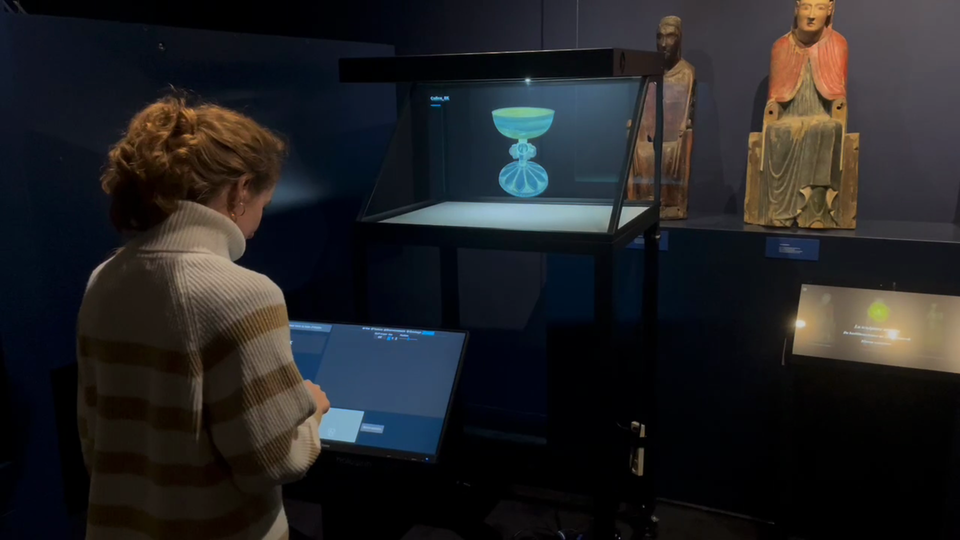
Visitor interacting with the holographic display at the TreM.a museum in Namur

A National Treasure with Conservation Constraints

The TreM.a, Museum of Ancient Arts in Namur (Belgium), holds one of the seven wonders of Belgium: the Treasury of Oignies. Over fifty pieces of medieval goldwork, crafted in the 13th century by Brother Hugo of Oignies and his collaborators, showcase an exceptional mastery of niello, filigree, and sculpted forms.

But these masterpieces—made of precious metals and stones—are extremely sensitive to environmental conditions. Protected in climate-controlled display cases, their lighting does not always reveal the fineness of the filigree or allow visitors to observe the richly decorated reverse sides. A familiar challenge for curators: how to offer a complete visitor experience without exposing the works to risk?

3D Digitization for Heritage Valorization

On the occasion of the Marvelous Treasure of Oignies: Splendors of the 13th Century exhibition at the Musée de Cluny in Paris, the treasury pieces were restored and digitized in 3D through photogrammetry by the Université Libre de Bruxelles.

These high-resolution 3D models were integrated into eCorpus, the open-source 3D corpus management platform powered by Holusion, the University of Lille, and the University of Liège. Each artifact is documented, annotated, and accessible remotely to researchers and the general public alike.

But the real innovation lies in the next step: how to turn these digital assets into a genuine mediation tool within the museum itself?
An Interactive Holographic Display Designed for Museums

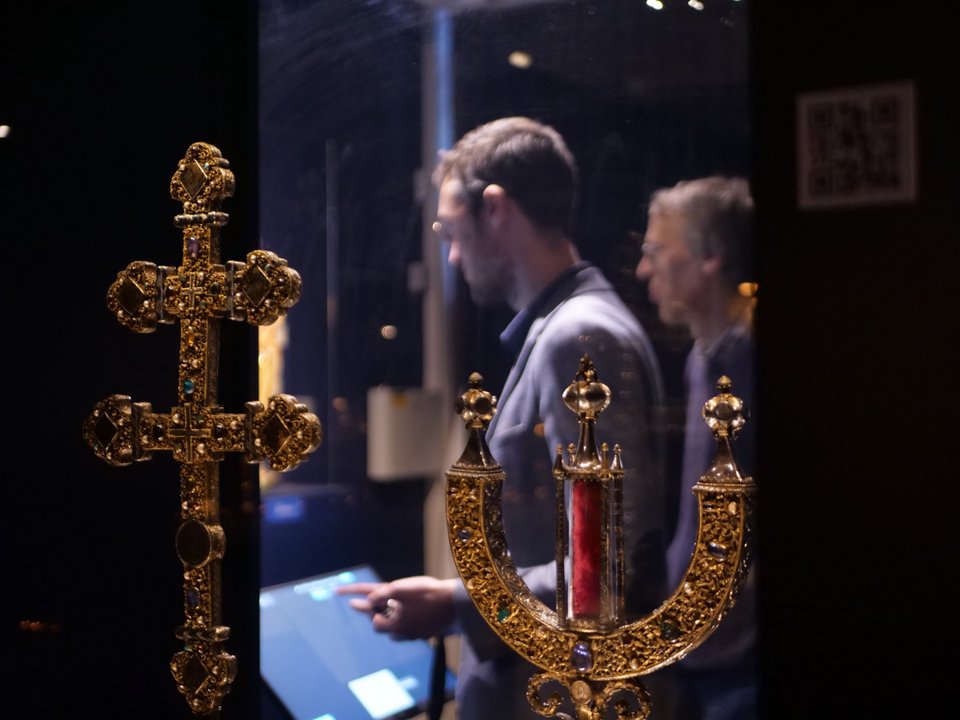
Medieval goldwork pieces exhibited at the TreM.a museum in Namur, with the holographic device visible in the background

The TreM.a museum chose to acquire from Holusion an Iris 32 holographic generator coupled with a touchscreen and a dedicated eCorpus application. This turnkey solution displays a selection of the collection's most emblematic artifacts in high resolution, with full interactive freedom.

Visitors can zoom, rotate, and explore each reliquary from every angle—including parts invisible in the display case, such as the reverse sides or the interior of the reliquaries. Semantic annotations integrated through eCorpus enrich the experience: historical descriptions, analyses of goldwork techniques, points of interest.

A tool for mediation and research

Beyond its appeal to visitors, this device becomes a working tool for curators:

  • Augmented guided tours: guides use the hologram as a presentation aid, highlighting details accessible to a wide audience
  • Collaborative research: scientific teams directly document artifacts in eCorpus, enriching the database as discoveries are made
  • Accessibility: visitors with reduced mobility, remote audiences, and younger visitors benefit from a close-up experience impossible at traditional display cases
  • Mobility: the display is transportable—it can be deployed in schools, libraries, and heritage events

A Complete Approach to Digital Heritage Valorization

The Namur installation perfectly illustrates Holusion's approach to heritage institutions: a complete journey from digitization to valorization.

Whether you are a museum, archive center, local authority, or collection manager, we support you through:

  • 3D digitization of your collections (photogrammetry, lasergrammetry)
  • Integration into eCorpus: open-source, collaborative, interoperable platform
  • Interactive display design: holograms, touchscreens, custom devices
  • Mediation and distribution: custom applications, training, editorial support

The Iris 32, coupled with eCorpus, is an interactive digital showcase that gives artifacts a second life, makes them accessible to everyone, and deepens understanding. A lasting investment for institutions seeking to combine preventive conservation with visitor engagement.

Do you have a digital valorization project?

Whether you want to digitize an entire collection, create an interactive display, or simply explore the possibilities of eCorpus, our team is here to help.

Credits

3D digitization of the artifacts: Université Libre de Bruxelles.
eCorpus platform: Holusion, University of Lille, University of Liège.
Iris 32 holographic display: Holusion.
eCorpus application design: Holusion.

Read the original article on the eCorpus blog →