Augmented relief map

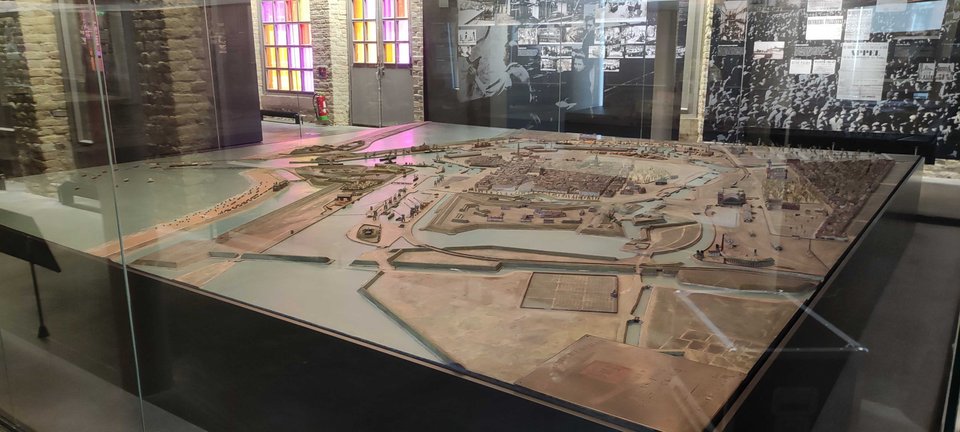
Relief map of Calais in the early 20th century, displayed under glass

A century-old relief map comes to life

In spring 2026, visitors to the Cité de la Dentelle et de la Mode in Calais can see the relief map of the city as it was at the beginning of the 20th century come to life. Created for the 1904 World's Fair by a local industrialist, owner of the Hénon factory, it depicts the port city in the midst of its industrial boom.

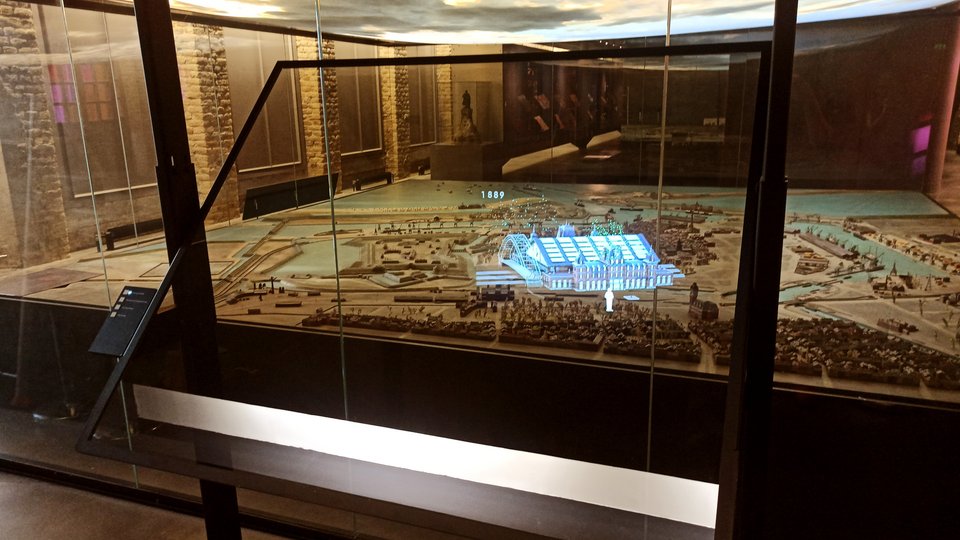
Mediation on this 25 m² relief map is a tricky issue: protected under glass for conservation purposes, it is impossible to point out places of interest without risking damage. This is where holograms come into play! Using an optical illusion based on Pepper's ghost, we were able to make key information appear at their exact locations on the map.

Combining 2D and 3D animations, this augmented reality device follows on from experiments conducted in 2021 and presented in a previous article about the project.

Relief map of Calais in the early 20th century, displayed under glass

When big History meets small stories

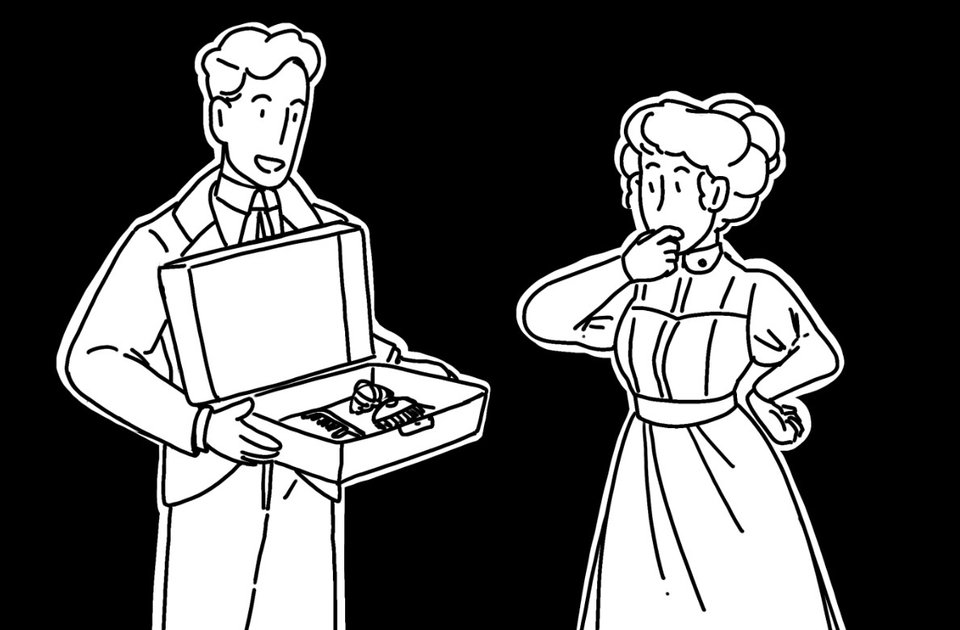
A true witness to Calais's demographic transition during the textile industrialization of the 20th century, this relief map can feel quite silent for unprepared visitors. To give it a voice and a personality, the device features two characters: Lucien and Louise.

Lucien is a traveling salesman for a textile house. He arrives in Calais for the first time and is seduced by the city and its economic promises, eventually settling there. He starts a family with Louise, a factory worker. Together, they witness the key events that transformed their city.

The tour highlights four points of interest on the relief map: the old central train station, the Six Bourgeois monument, the Henri Hénon factory, and Calais City Hall. Each features a specific scene where buildings appear at their location, then expand to full size, allowing close-ups on architectural details.

Beyond adding a fun and entertaining dimension, this small-scale story provides a fully guided animated tour of the relief map. Thanks to the holographic device, it is even possible to display points of interest that were not represented on the original map, or that have moved to different locations over time — as is the case with the Six Bourgeois monument.
Mediation and design

Optical principle of holographic mapping on the relief map

Dating back to 1904, the exhibited relief map is all the more precious for being fragile. Protected under glass, it is impossible to point out places of interest directly on the model. No scenography that could damage the work itself could be considered.

The hologram provided the solution. The device relies on an original optical principle: facing a large glass pane mounted on a metal structure, visitors see three-dimensional holograms appear — only when they are properly positioned. As Delphine Nicola, head of public services, explains: "This is not a projection, it's really an optical illusion." From the side, nothing is visible; from the front, a narrative universe comes to life, blending animated characters, 3D models and archival documents.

Designed on a custom basis to fit the museum's existing scenography, the device was built to be immersive and inclusive: a soundtrack transports visitors into the atmosphere of the era, and an interactive button lets them trigger the narration at will. The space was also designed to be easily accessible to people with reduced mobility.

A project carried from start to finish

This project is the culmination of several years of collaboration between Holusion and the Cité de la Dentelle et de la Mode. After an initial prototype presented during the 2021 Heritage Days focused on the central train station, the device has been expanded to now cover four iconic sites in the city.

The production involved a multidisciplinary skillset: 3D modeling of buildings, photogrammetry of artworks, digitization of archives, character animation for Lucien and Louise, sound design, and interactive system development. Every step was designed to offer a smooth and intuitive experience where visitors remain active participants in their discovery.

As Anne-Claire Laronde, director of Calais museums, puts it: "We didn't want to add digital for the sake of adding digital." The goal was above all to tell stories, evoke emotion, and go beyond a simple architectural description.

Acknowledgments and credits

Holographic immersive mediation device around the 1900 relief map of Calais, combining holographic mapping, sound narration and interactivity. Four points of interest are staged through the characters of Lucien and Louise.

Image synthesis, design and production by Holusion, in collaboration with the CITÉ DE LA DENTELLE ET DE LA MODE of Calais and the City of Calais.

Acknowledgments to Anne-Claire Laronde (director of Calais museums), Delphine Nicola (head of public services) and all the teams at the Cité de la Dentelle et de la Mode for their trust and support throughout the project.

For further reading: